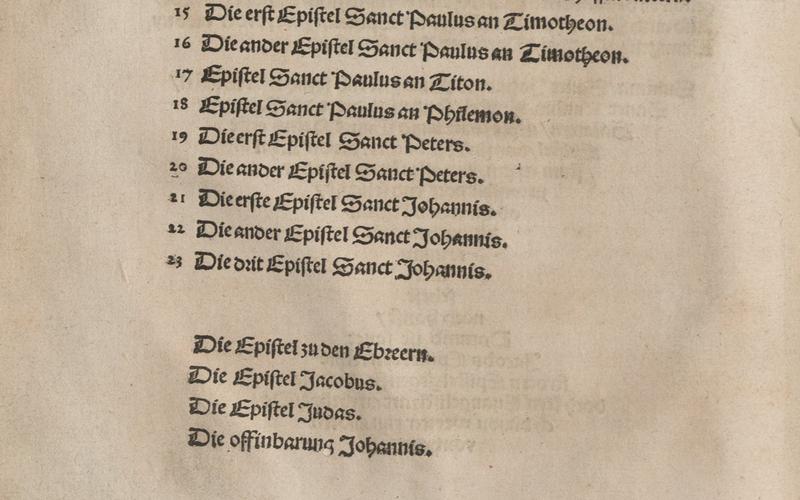
Luther’s 1522 New Testament: The Four Books He Set Apart
Did Luther remove books from the Bible? Not from the New Testament. In 1522 he set four apart: Hebrews, James, Jude, and Revelation. What he did, and why.
· 60 min read
Nicaea, Ephesus, Chalcedon, Trent, and the Vatican councils: what each was called to settle, what it actually defined, and the creeds that came out of them.
30 articles in this topic
Did Luther remove books from the Bible? Not from the New Testament. In 1522 he set four apart: Hebrews, James, Jude, and Revelation. What he did, and why.

Nestorianism split Christ into two persons and refused to call Mary Theotokos. Here is what Nestorius actually taught, how Ephesus answered, and why the 'Nestorian Church' is misnamed.

Eunomianism, the radical Arianism of Aëtius and Eunomius, claimed God’s essence could be fully known—and was condemned at Constantinople in 381.

Marcellus of Ancyra fought Arianism so hard he fell into the opposite error—a Trinity that expands and contracts. The Creed's 'no end' clause answers him.

Photinus of Sirmium taught that Christ was a mere man, exalted but not preexistent. His name became the early Church's shorthand for denying the Incarnation.

The Pneumatomachians ('Spirit-fighters') denied the Holy Spirit's divinity. Their challenge produced the third article of the Creed at Constantinople in 381.

The filioque—'and the Son'—is the word that helped divide Christendom. Its biblical roots, the long schism, and why Rome and Orthodoxy are closer than most think.

A scholarly Catholic history of the sacrament of reconciliation: its biblical, patristic, medieval, and Reformation roots, for curious Protestant readers.

The First Council of Constantinople (381) confessed the Holy Spirit’s divinity, completed the Creed we recite at Mass, and became the Second Ecumenical Council.

A Catholic convert reads the Council of Trent's 1547 Decree on Justification verbatim—and finds that what Protestants are taught it says is not what it says.

A Catholic exegesis of 2 Kings 13:20–21: the Hebrew, the LXX, Sirach 48, and the patristic case that Elisha's bones warrant relic veneration.

What the deuterocanonical books (the seven books most Protestants call the Apocrypha) are, where they came from, and why Christians disagree about them.

The Council of Trent (1545–1563) answered the Reformation, defined Catholic doctrine on Scripture, justification, and the sacraments, and reshaped the Church.

Ephesus (431) condemned Nestorius, defined Mary as Theotokos, and fixed the single-subject Christology every later ecumenical council inherited.

Did the Catholic Church ban the Bible? Examining the councils, indices, and regional restrictions—what's myth, what's exaggeration, and what's actually true.

How Catholic inerrancy handles the conquest of Canaan, the Aqedah, the imprecatory psalms, and other hard Old Testament passages. Five approaches.

Canon 28 of the Council of Chalcedon (451) recognized Constantinople as 'new Rome' with privileges second only to old Rome. Why Pope Leo rejected it — and why it still matters.
What is the Chalcedonian Definition? The 451 AD formula declared Christ is one person in two natures — divine and human — 'without confusion, without change, without division, without separation.'

What is Arianism? A Catholic guide to the Arian heresy — what Arius actually taught, why it was condemned at Nicaea, and why the debate over Christ's divinity still matters.

Did Constantine invent Christianity or choose what books went in the Bible? A historian's guide to what Constantine actually did — and didn't do — at the Council of Nicaea.
What does the Nicene Creed mean? A Catholic phrase-by-phrase guide to the full text of the Niceno-Constantinopolitan Creed — its history, theology, and why it still matters.

From 36,000 members to under 14,000—what happened to the Jesuits? A historically grounded Catholic assessment of the Society of Jesus's decline.

A comprehensive examination of the Catholic Counter-Reformation: the Council of Trent, the founding of the Jesuits, and the Church's response to the Protestant Reformation.

Vatican I defined papal infallibility and primacy while defending faith against rationalism. Explore its two major constitutions, the context that prompted it, and its enduring significance for Catholic theology.

What does Lumen Gentium 16 teach about salvation outside the Church? A clear Catholic explanation of LG 14-16, extra ecclesiam nulla salus, and invincible ignorance.
What happened at the First Council of Nicaea in 325 AD? A Catholic examination of the Arian crisis, the meaning of homoousios, and why the Nicene Creed still defines Christian orthodoxy.

What is the Holy Trinity? A Catholic explanation of one God in three persons — the scriptural foundations, Nicene doctrine, and why it matters for the Christian life.

Apollinarius of Laodicea denied that Christ had a human rational mind, replacing it with the divine Logos. Gregory of Nazianzus's devastating reply—'what is not assumed is not healed'—sealed the condemnation at Constantinople I (381).
Get new writing on faith, law, and service delivered to your inbox.
No spam. Unsubscribe anytime.
